
One has to wonder what is so wrong with the European Union.

The leaked documents include details of submarine's underwater sensors, above-water sensors, combat management system, torpedo launch system and specifications, communications system and navigation systems.

'Whether it's investments in Kashmir, building naval facilities, or selling top-of-the-range military equipment, Pakistan could well benefit more under Xi's watch.' 'Do Chinese concerns about the 'Islamisation' of Pakistan give it pause about how quickly to move forward with security and economic projects? At the moment the indication is quite the opposite: China is doubling down on its support to Pakistan, partly because of its fears about where the country is headed.'
.jpg)
Modi government must push reforms at a fast pace to restore growth.
'Pakistan is paying the price for ignoring secularism. In seeking to be ever more Muslim to define its nationhood, it has become a terrorist haven.'

Amberish K Diwanji on Indian prime ministers and the seven-year itch.

'One big problem for the RSS is, while they spread their ideology of hard, Hindu-ised Indian nationalism, the absence of their own pantheon of modern nationalist giants. They missed out on the freedom movement quite comprehensively, in some ways comparable to the Muslim League and latter-day Communists. They have to find heroes elsewhere.' 'They borrow who they can from the Congress, like Madan Mohan Malviya and Sardar Patel, and then steal the entire lot of revolutionaries, from Bhagat Singh to Netaji, never mind that many of them were extreme leftists.'

Do Modi's foreign visits actually serve India or they nothing more than expensive tools for domestic positioning and image-building, asks Shehzad Poonawalla.
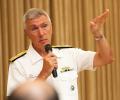
Admiral Samuel J Locklear III, Commander of the US Pacific Command, has not ruled out militants fighting in Afghanistan today switching their attention back to Kashmir post-US and NATO withdrawal of its troops from Afghanistan, and expressed concern over the recent terrorist attacks across the Line of Control that has exacerbated tensions between India and Pakistan.

The biological weapons convention is a non-starter in spite of the efforts of many states in the world for the last five decades mainly because the US is not ready to accept the 'verification protocol' which could allow the formation of some official mechanism for inspections, says Ajay Lele.

'The military in Pakistan is capable and self critical, but intelligence is stuffed full of lifers who resist change, which is why career soldiers in Pakistan try with all their might not to be transferred into the ISI.'

'It would not be incorrect to say that the Chinese-Pakistani strategy of containing India began in the aftermath of the 1965 war.'

Ravindra Shukla picks out his best option.

As Japan beefs up its defences against China, both New Delhi and Tokyo seem to have decided to re-energise their relationship to ensure a strategic balance in Asia. It is a clear signal that they may be ready to work together in containing if not confronting China, says Nitin Gokhale.

'The government must make clear once and for all that promotions in the Indian Army are not the right of individuals, but a privilege given in accordance with role and function.'

Here's the full text of Prime Minister Narendra Modi's address to the United States Congress.

'A participant in many rounds of the border talks with China once told me that China seemed not interested in resolving the border issue as it wanted to keep it as a ready excuse to intervene in the sub-continent,' says Colonel (retd) Anil A Athale.

'The year in pictures' treks across the globe, looking back on the moments that shaped 2016. From the United States presidential race, to demonetisation in India to the refugee crisis, the news has kept pouring in. Here are our top 50 moments from the world.

Prime Minister Narendra Modi on Tuesday said Australia will not be at the periphery of India's vision but at the centre of its thought, as he called for closer bilateral security cooperation and a comprehensive global strategy to tackle the menace of terrorism.

In his penultimate State of the Union address, Barack Obama said that the economy is improving.

Read the full transcript of President Obama's State of the Union address on Wednesday at the US Capitol in Washington.

President Pranab Mukherjee on Monday addressed the first joint sitting of Parliament as mandatorily required under the Constitution after the general elections. The address is the political, economic and foreign policy road map of the Narendra Modi government and covers virtually all crucial areas.
